Sola-Site-Logo
Search

Home » Blog » Restaurant Patio Shade: Pergola vs Awnings (2026 Guide)

Restaurant Patio Shade: Pergola vs Awnings (2026 Guide)

wilight restaurant outdoor patio large butterfly awing over dining tables guests dining under warm lights
Walk past a packed restaurant patio on a warm evening and notice what the full tables have in common: real shade. Guests who are comfortable stay longer, order another course, and come back next week.
But most restaurant patio shade setups are an afterthought. A few umbrellas block one table and blind the next. A cheap awning sags, fades, and can't hold up in a gust. And by the time the sun moves, the shade is gone before dinner. The result is patio seating you can only sell on perfect days.
The hard part is choice. Pergola, awning, canopy, louvered roof — each gets pitched by a different supplier, and they all sound good. This guide cuts through it. We compare the three shade types that actually fit a restaurant patio — solar pergola, butterfly awning, and retractable awning — show what each does best, and give you a simple way to pick.
New to commercial shading? Our restaurant pergola buying guide covers the full picture before you decide.

What Restaurant Patio Shade Do You Actually Need?

Before you compare products, define the job. Four questions narrow the choice fast:
  • How much space are you covering? A small storefront nook needs something compact. A full dining terrace needs a structure with real span.
  • Permanent or flexible? Do you want a fixed structure that's there every day, or shade you can open, close, and put away as weather and service change?
  • Can you power it? Motorized shade needs electricity — unless it runs on solar. That single question decides your install cost and your monthly bill.
  • What's the look? On a busy street, shade is also your storefront. Some owners want a quiet, practical structure; others want something that stops foot traffic.
Write down your answers before you look at products. The right restaurant patio shade becomes obvious once you know these four things.

Restaurant Patio Shade Options: Pergola vs Awning

Solar pergolas and awnings transforming luxury suburban backyard patio with versatile outdoor shade structures and poolside living space
Restaurant patio shade broadly splits into two families: pergolas (a permanent framed structure with a roof) and awnings (a fabric or panel cover that extends and retracts). Within each family, one style usually fits a restaurant best.
Here's the honest comparison:
  • A solar pergola is a permanent aluminum structure with a motorized louvered roof. It covers a defined space, stands up to wind and rain, and works year-round. It's the heavier investment — and the one that turns a patio into a dining room.
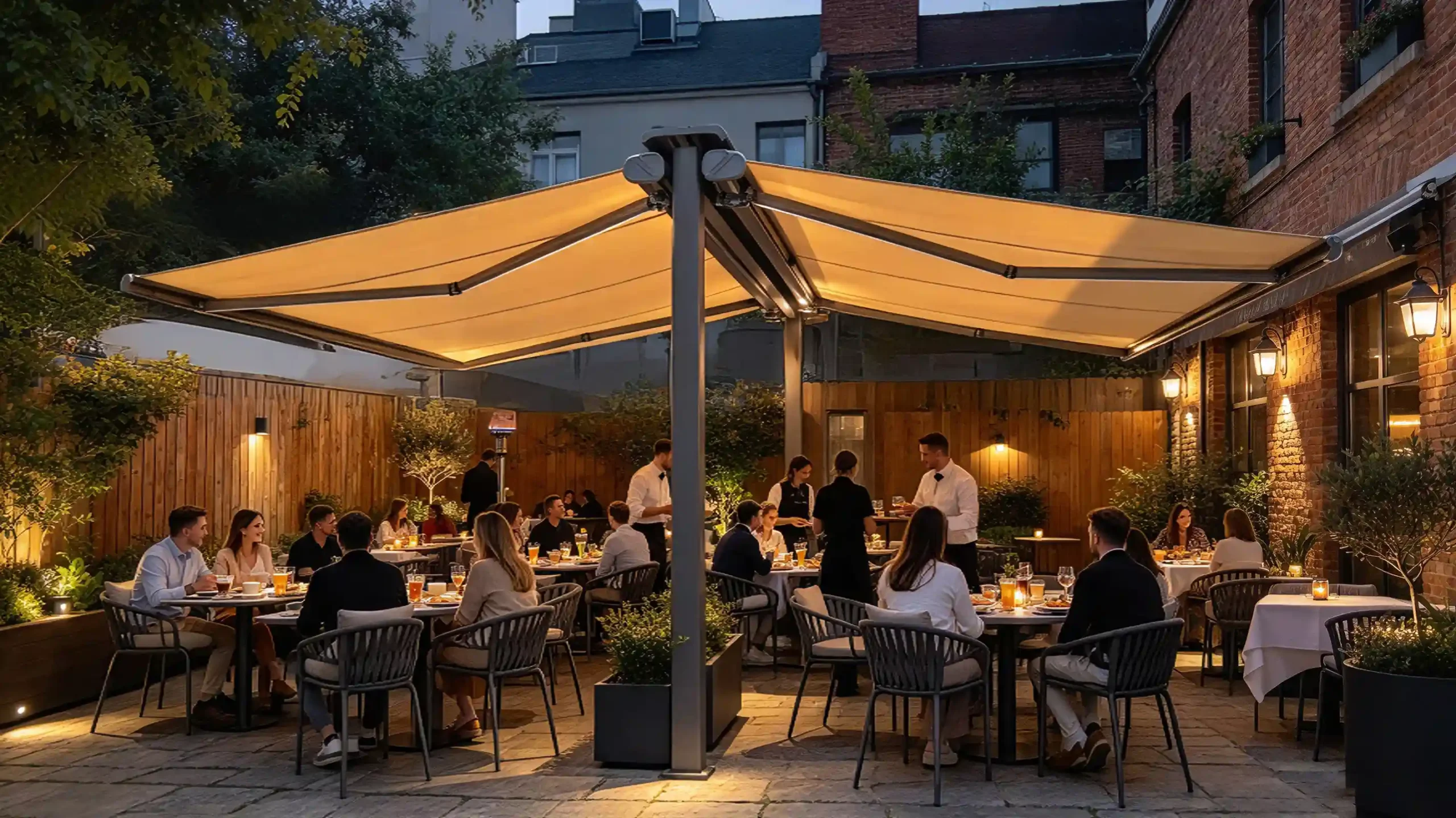
  • A butterfly awning is a solar-powered wing-shaped awning that extends and retracts to control how much shade it casts, and lights up. It's a statement piece — perfect for a storefront or cafe that wants shade that doubles as a sign.
  • A retractable awning (Y-style) is a freestanding fabric cover on a Y-frame that opens and closes on demand. It's the most flexible option: no wall needed, space-saving, and easy to put away.
None of these is "best" in general — each wins in a different scenario. The rest of this guide shows you which one matches your patio.

Option 1: Solar Pergola for Restaurants

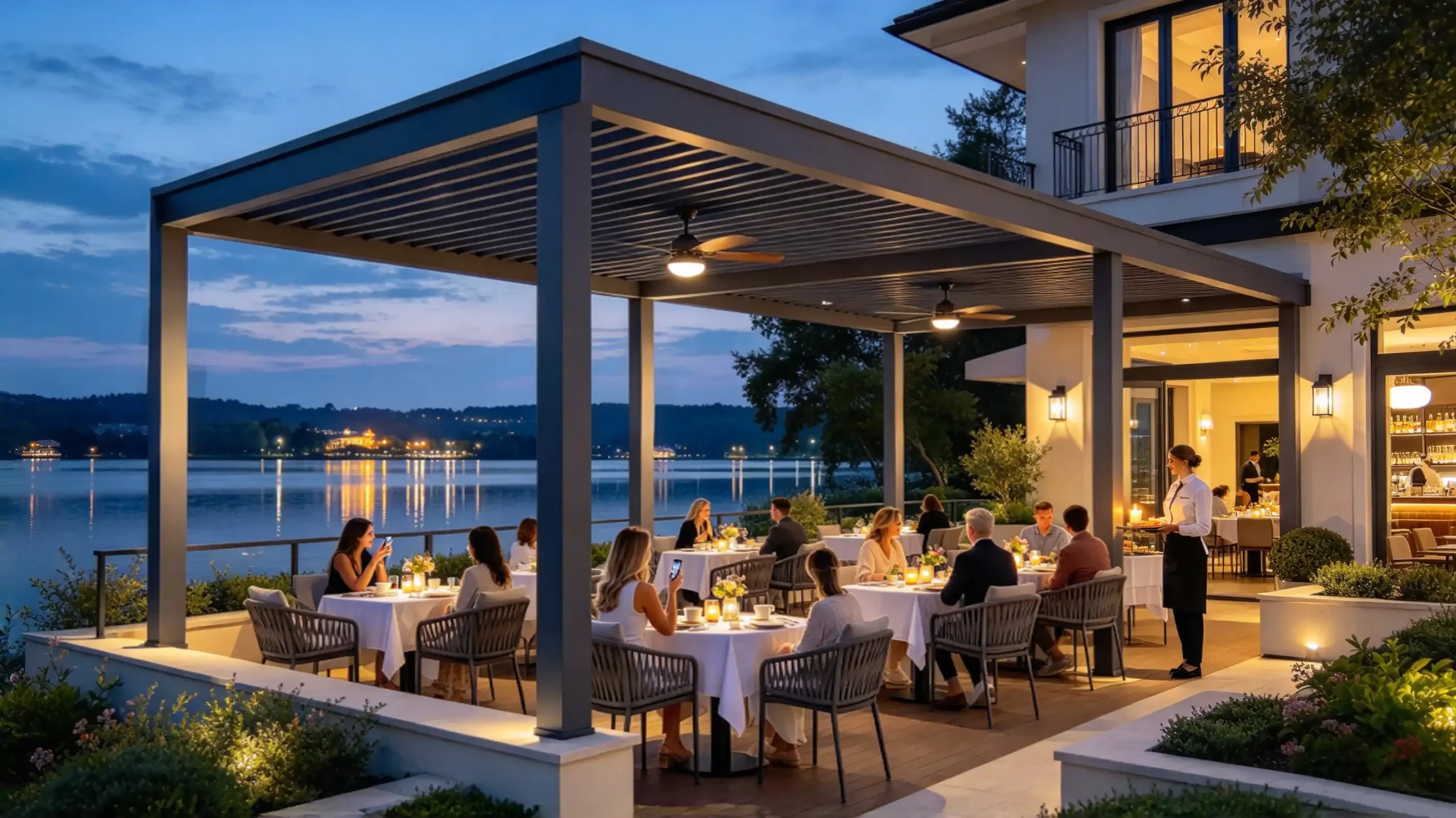
twilight lakeside restaurant patio motorized louvered pergola guests dining lake view warm lights
A commercial pergola is a fixed structure: a powder-coated aluminum frame with a motorized louvered roof that opens for sun, tilts for partial shade, and seals shut for rain. Because it's built into your space, it's the restaurant patio shade option that works in every season.
What it handles well:
  • Large terraces and full dining rooms. One pergola covers a row of tables with a real span — up to 13×28 ft or larger for multi-unit layouts.
  • Rain, heat, and wind. A louvered roof closes in seconds when a shower hits, and commercial pergolas are engineered for real wind and snow loads — not residential standards. Sola's commercial models are rated for high wind with a 10-year structural warranty.
  • Extending the evening. Built-in LED lights and ceiling fans keep a patio usable after dark and comfortable in summer heat.
The trade-off: a pergola is a bigger investment and a permanent fixture. If you want shade you can remove or relocate, it's not the answer. If you want a dining room that works all year, it is.

Option 2: Butterfly Awning for Cafes & Streetfronts

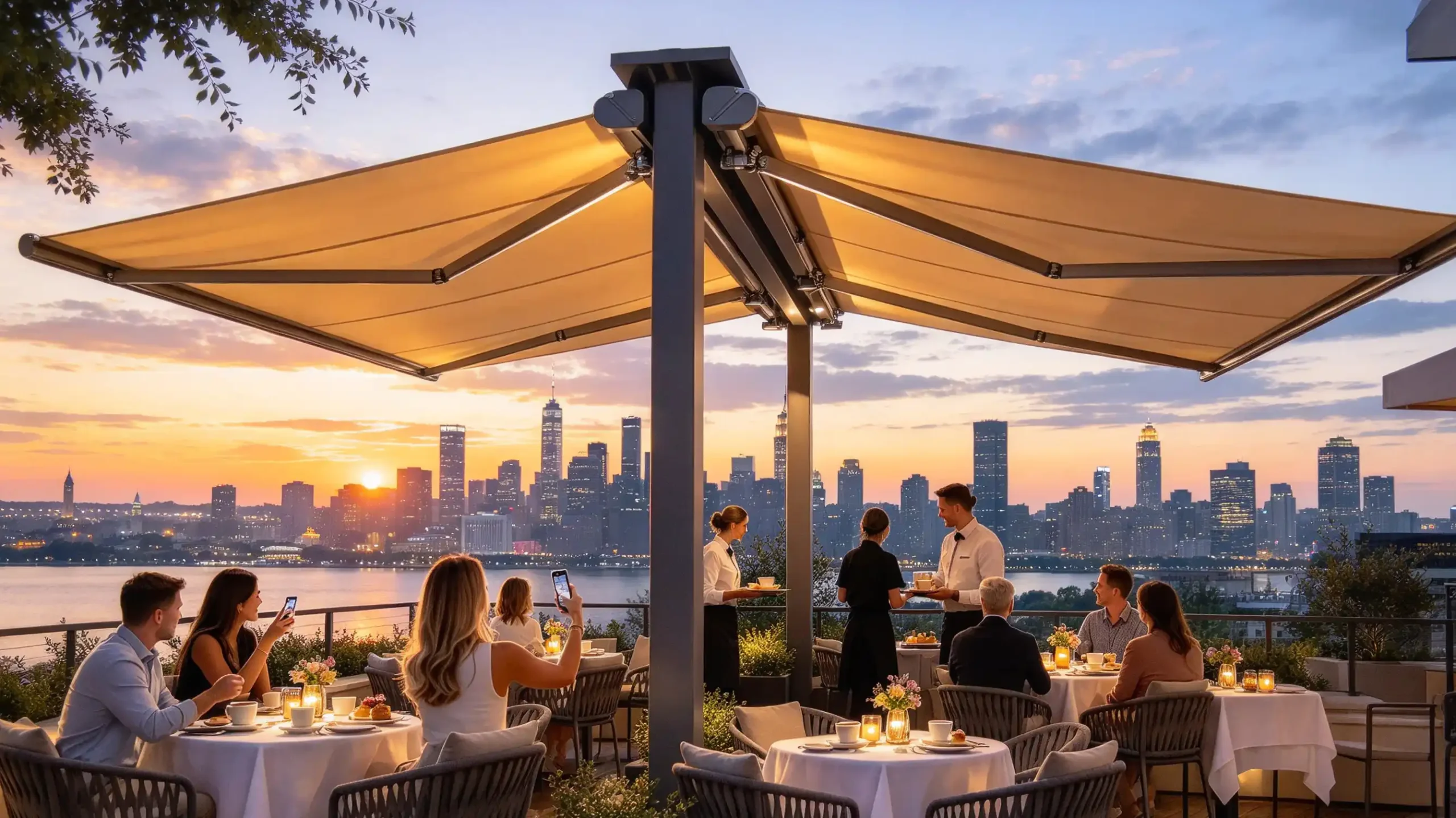
rooftop restaurant patio sunset butterfly awning guests dining city skyline view
The butterfly awning is a solar-powered awning shaped like spread wings. It's engineered to be the focal point of a space: curved arms fold the wings out to their full spread or tuck them back into a full cassette, letting you control how much shade the fabric casts — and it lights up at night, all powered by its own solar panel, so there's zero wiring and zero electricity bill.
 
Where it earns its keep:
  • Streetfront and sidewalk seating. A butterfly awning turns an ordinary awning spot into something people photograph. For a cafe that trades on its look, that first impression is the marketing.
  • Moderate coverage with a strong statement. It covers a defined seating area (10×10 ft up to 13×28 ft in combined modules) while giving the front of your business a landmark shape.
  • Rain and wind protection. A reinforced aluminum frame with heavy-duty steel arms resists strong wind, and dual drainage ports keep the space dry in a shower. The fabric is UPF 50+, water-repellent, and fade-resistant.
Because it runs entirely on solar, there's no motor wiring or monthly power cost for the lighting — a real saving for a storefront that keeps evening hours.
 
The trade-off: a butterfly awning shades a defined zone, not a full terrace. If you need to cover a wide dining floor, a pergola is the better structure.

Option 3: Retractable Y-Style Awning

Y-style retractable awnings shading poolside lounge chairs at a tropical resort swimming pool
The Y-style awning is a freestanding retractable cover on a Y-shaped frame. It doesn't mount to a wall, so it works almost anywhere: a sidewalk strip, a pop-up bar, a patio edge you only use in the evening. When you don't need it, the fabric and arms retract fully into a clean cassette and get out of the way.
What it's built for:
  • No wall, no problem. Freestanding by design — install it wherever you want shade, with no structural mounting.
  • Flexible service. Open it for the lunch rush, retract it after close — adjusted by an electric motor.
  • Tight spaces. The cassette and space-saving frame fit narrow sidewalks and tight patio layouts where a full structure won't.
  • Pairing with a pergola. A Y-style awning mounts under or beside a pergola to extend shade over a bar area or pickup counter — a common combo for restaurants that want the main terrace covered and the edges flexible.
The trade-off: it's fabric-based, so it's not a year-round all-weather structure like a pergola. It's the shade you pull out when and where you need it — not a permanent room.

Why Solar for Your Restaurant Patio?

Every option above works with solar power. A traditional motorized shade has to be hardwired by an electrician and then costs money to run every month. A solar-powered one doesn't.
What solar changes for a restaurant:
  • Zero wiring. No trenching, no electrician, no running cables across your patio. Solar shade sits on its own panels.
  • Zero monthly power cost. The pergola's lights, fans, and louvers — or the awning's motor and lighting — run off stored solar energy. On cloudy days, battery storage keeps them working into the evening.
  • Lower install cost. Because there's no electrical work, the "getting it installed" part is smaller and faster.
When you compare restaurant patio shade quotes, ask whether the motor, lights, and fans need hardwiring. If they do, add an electrician and a monthly bill to that price. Solar removes both — which is why it pays for itself as it runs.

How to Choose

Put it together with a three-step decision:
Step 1: Match the job to the type.


Step 2: Confirm the space and power. Measure the footprint you want covered, and confirm your shade runs on solar so there's no electrical work to budget for.
 
Step 3: Get an itemized quote. Ask for a breakdown covering the structure, installation, and any site work — and compare on capability and warranty, not just the lowest number.
 
If you're ready to price your restaurant patio, Sola provides custom quotes based on your exact space. Explore commercial pergola options or request a quote with your patio dimensions.

FAQs About Restaurant Patio Shade

Which restaurant patio shade is cheapest?

Typically a retractable awning is the lower upfront investment, followed by a butterfly awning, with a solar pergola the largest because it's a permanent structure with a louvered roof. But running cost matters too: solar-powered options carry no monthly electricity bill for their lights, fans, and motors.

Can I add shade to an existing restaurant patio?

Yes. All three options install on existing patios. A pergola needs footings or wall support, a butterfly awning needs a mounting point, and a Y-style awning stands free — the easiest to add anywhere with no structural work.

Will a solar-powered shade work on cloudy days?

Yes. Solar shade stores energy in a battery, so the motor, lights, and fans keep working through cloudy days and into the evening — with no connection to your building's power.

Which option lasts longest?

A commercial solar pergola is the most durable — an all-aluminum structure with a marine-grade powder coating and a 10-year structural warranty. Fabric awnings last for years too, but the pergola's frame is built to stand up to wind and snow indefinitely.

Do I need a permit for restaurant patio shade?

Most commercial shade structures require a permit, and rules vary by city. A supplier with commercial experience can advise on local requirements and provide the structural details your permitting office needs.

Conclusion

Restaurant patio shade isn't one product — it's a decision between a permanent solar pergola, a statement butterfly awning, and a flexible retractable awning. Match the type to your space, run it on solar to skip the wiring and the electric bill, and you turn an empty patio into seating you can sell most of the year.
If you're ready to shade your patio, explore commercial pergola options or request a quote with your patio dimensions today.
Back to top of page
crossmenu