Sola-Site-Logo
Search

Home » Blog » Best Louvered Pergolas (Wall-Mounted) Buying Guide

Best Louvered Pergolas (Wall-Mounted) Buying Guide

Best Louvered Pergolas (Wall-Mounted) Buying Guide

If you're looking for the best louvered pergola for your backyard, you're comparing wall-mounted louvered pergolas—premium structures that attach directly to your house, close into a watertight roof when it rains, and open up effortlessly when you want full sunlight. That is not an $1,800 Amazon kit; that is an architectural investment you will live with for twenty years.

Most "best louvered pergola" roundups simply rank budget DIY kits by Amazon star ratings. While those guides are genuinely helpful if you want to assemble a basic structure on a budget, they fail to answer the critical question premium buyers are asking: How do you choose a wall-mounted, professionally installed louvered pergola that seamlessly matches your house and lasts for decades?

This comprehensive guide is written specifically for that buyer. It delivers an objective scoring framework you can take to any brand—Sola included—before spending a single dollar.
Why "Best" Is Harder Than It Looks

The word "best" means vastly different things at different price points. A $1,800 kit ranking first on e-commerce platforms might be the best low-cost option, but it is certainly not the best long-term structure for your home.

When evaluating a wall-mounted structure, structural integrity and flashing waterproofing take center stage. Therefore, evaluating a premium louvered pergola requires looking beyond surface aesthetics and examining verifiable engineering specifications. This guide gives you a repeatable scoring framework to judge whether a wall-mounted louvered pergola is truly worth your investment before you commit.

The Buyers Scorecard (Printable Checklist)

Here is the essential checklist to bring into any sales conversation. Score each dimension from 1 to 5, multiply by its weight, and total the results. A cumulative score of 4.0 or higher indicates a top-tier structural product.

#DimensionWeightYour Score (1-5)Weighted
1Watertight roof & drainage25%
2Real wind & snow ratings20%
3Frame material & lifespan20%
4Power source (solar vs wired)20%
5Installation & customization15%
Total100%

How to use it: Always ask the seller for specific numbers on each metric—not vague promises like "heavy duty" or "weatherproof," but certified ratings. If a manufacturer cannot provide exact figures, that serves as an immediate red flag.

The 5 Scorecard Standards, Explained

Standard 1: Watertight Roof & Drainage

The fundamental reason for upgrading to an adjustable louvered system is to stay completely dry. Two crucial questions determine this metric:

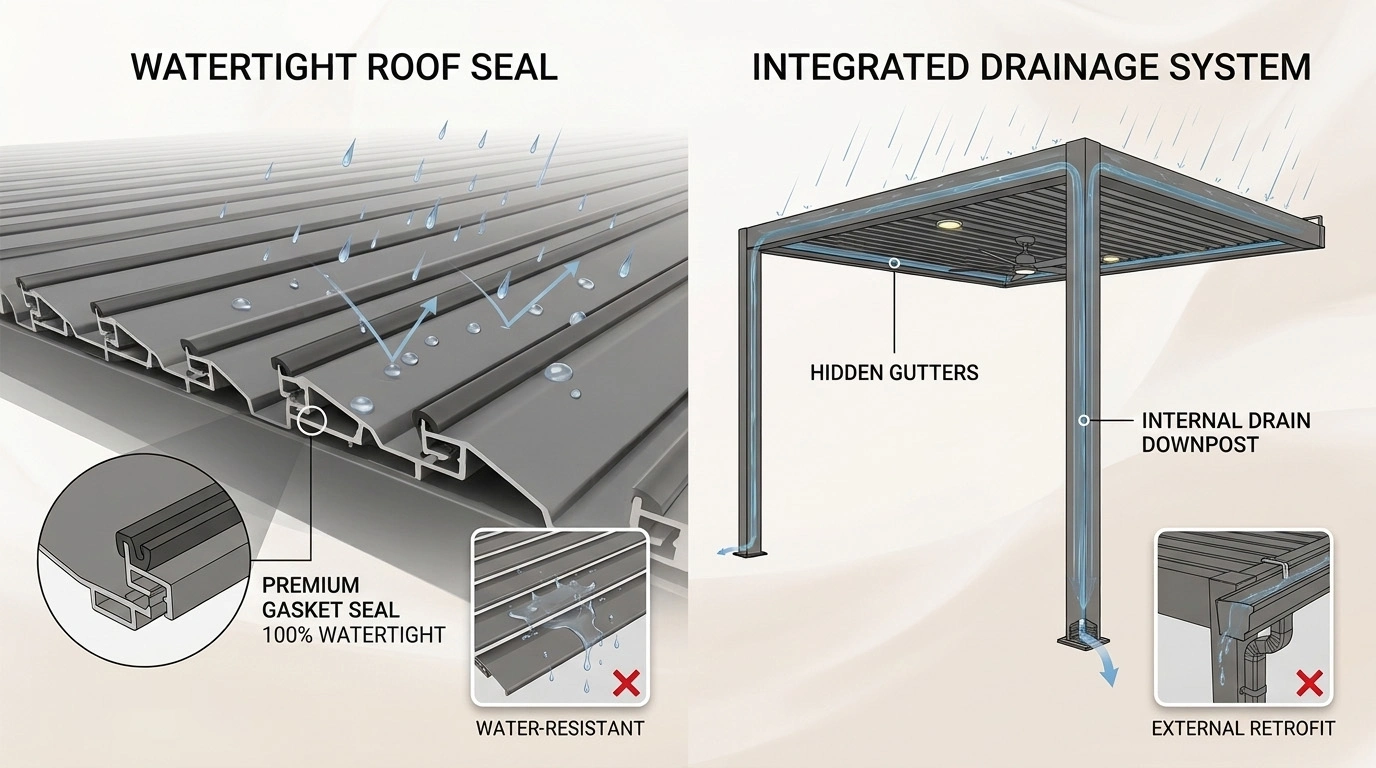
  • Does the roof actually seal when closed? Look for louvers engineered with high-grade rubber gaskets that compress tightly against adjacent slats and the outer frame. When closed, the surface should be watertight rather than merely "water-resistant."
  • Where does the water go? Premium systems channel rainwater into hidden, integrated gutters that drain internally down through the hollow frame posts. You should never see water dumping uncontrolled off the edges. In contrast, external gutters bolted onto the outer frame indicate a cheaper, retrofit design.

This is especially vital for a wall-mounted unit, as improper runoff flows directly toward your home's siding and foundation.

Standard 2: Real Wind & Snow Ratings

Don't accept generic marketing terms like "wind-resistant." Always insist on certified engineering metrics:

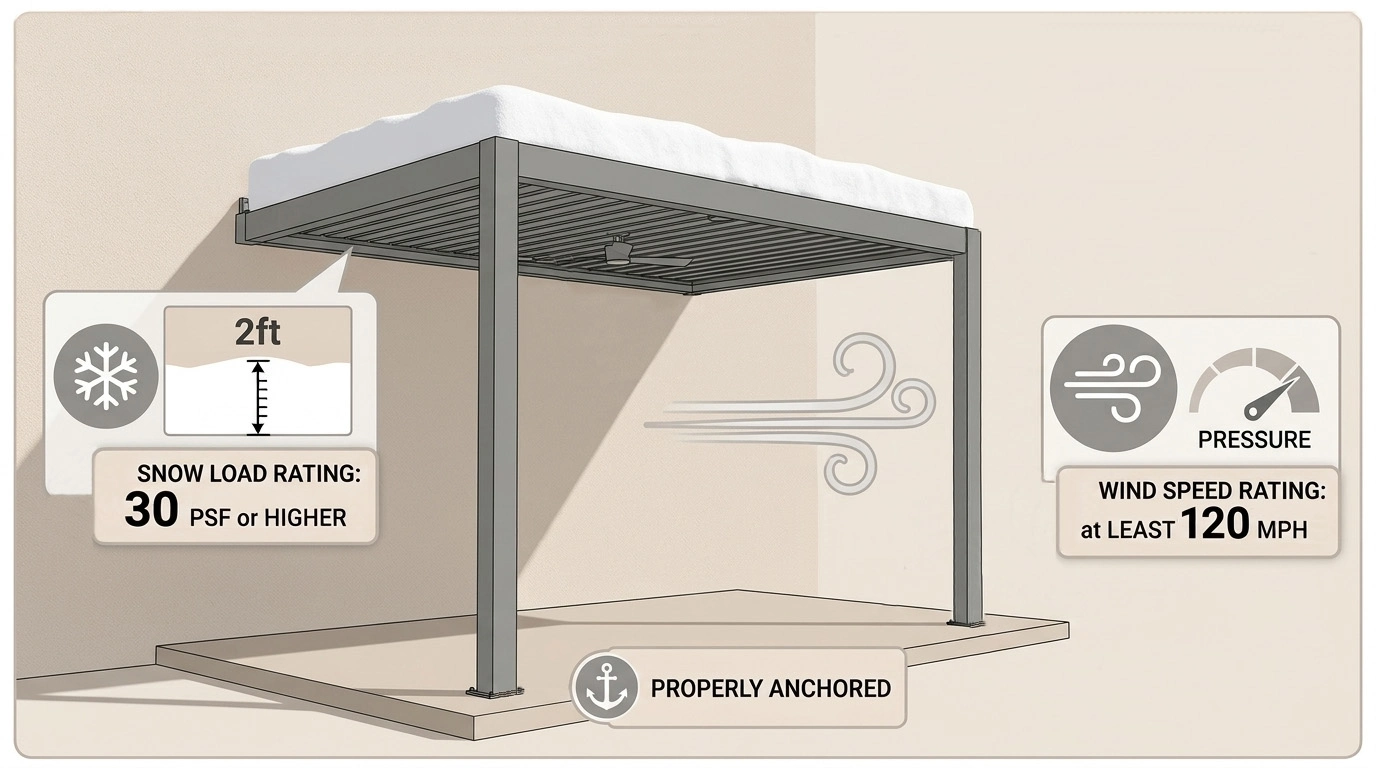
  • Wind rating:  A high-quality aluminum louvered pergola should be rated to withstand wind speeds of at least 120 mph when properly anchored—covering most US hurricane and coastal building codes.
  • Snow load:  Look for a certified rating of 30 PSF or higher, which handles roughly two feet of packed winter snow. Budget DIY kits often max out at a fragile 8–15 PSF.

These figures trace directly back to ASCE 7, the official engineering standard behind US structural codes. A brand quoting specific ASCE 7 numbers demonstrates real engineering compliance.

Standard 3: Frame Material & Lifespan

For a structure attached directly to your home, frame durability is paramount because moisture continually collects against your exterior walls:

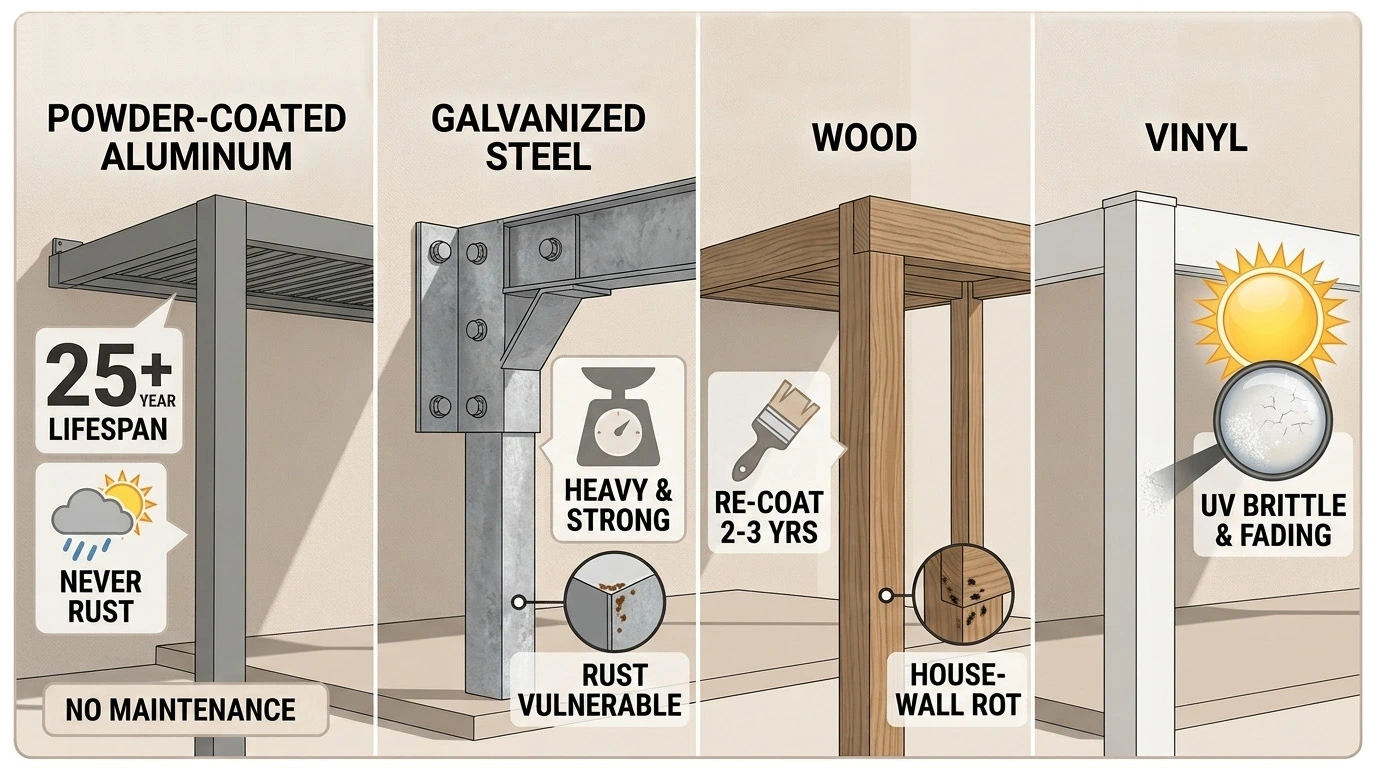
  • Powder-Coated Aluminum: The industry benchmark for a 20-to-25+ year lifespan. It will never rust, rot, or warp, requiring virtually zero ongoing maintenance beyond periodic cleaning.

  • Galvanized Steel: Extremely strong but exceptionally heavy. However, steel is harder to mount safely to residential walls and remains vulnerable to rust along cut edges over time.

  • Wood: Demands staining or painting every 2 to 3 years and remains prone to rot at the house wall junction.

  • Vinyl: Highly susceptible to fading, chalking, and becoming brittle under intense UV exposure.

Standard 4: Power Source — Solar vs Wired

A louvered pergola needs power for the motor, lights, and any fans. You have two options:

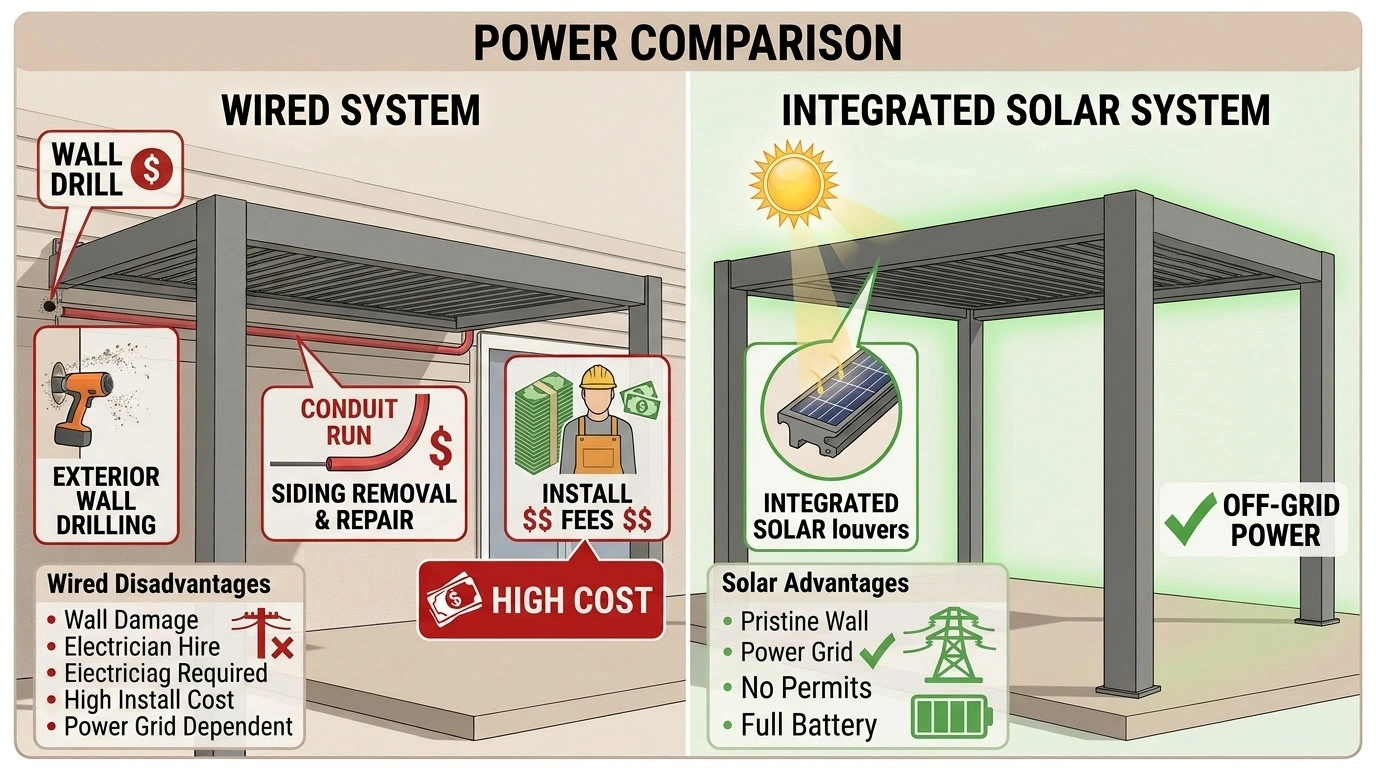
  • Wired Systems: The installer must run high-voltage conduit from your home to the pergola posts. For attached units, this means cutting into siding, drilling through exterior walls, hiring a licensed electrician, and paying $500–$2,000 extra in contractor and permit fees.

  • Solar Systems: High-efficiency solar panels integrated directly into the louvers capture daylight to power the motors and accessories off-grid. Integrated battery packs store energy for night use.

For a wall-mounted pergola, solar is clearly the superior choice. It eliminates messy 120V wiring, expensive electrical permits, and the leak-prone wall penetrations required by hardwired systems. This is why we build the solar panels straight into the roof of every Sola pergola — so the motor, lights, and fans run on sunlight alone, with no electrical work at all. See how that setup comes together.

Standard 5: Installation & Customization

Cheap kits follow a rigid "one-size-fits-all" formula. In comparison, premium wall-mounted pergolas offer custom sizing and professional setup:

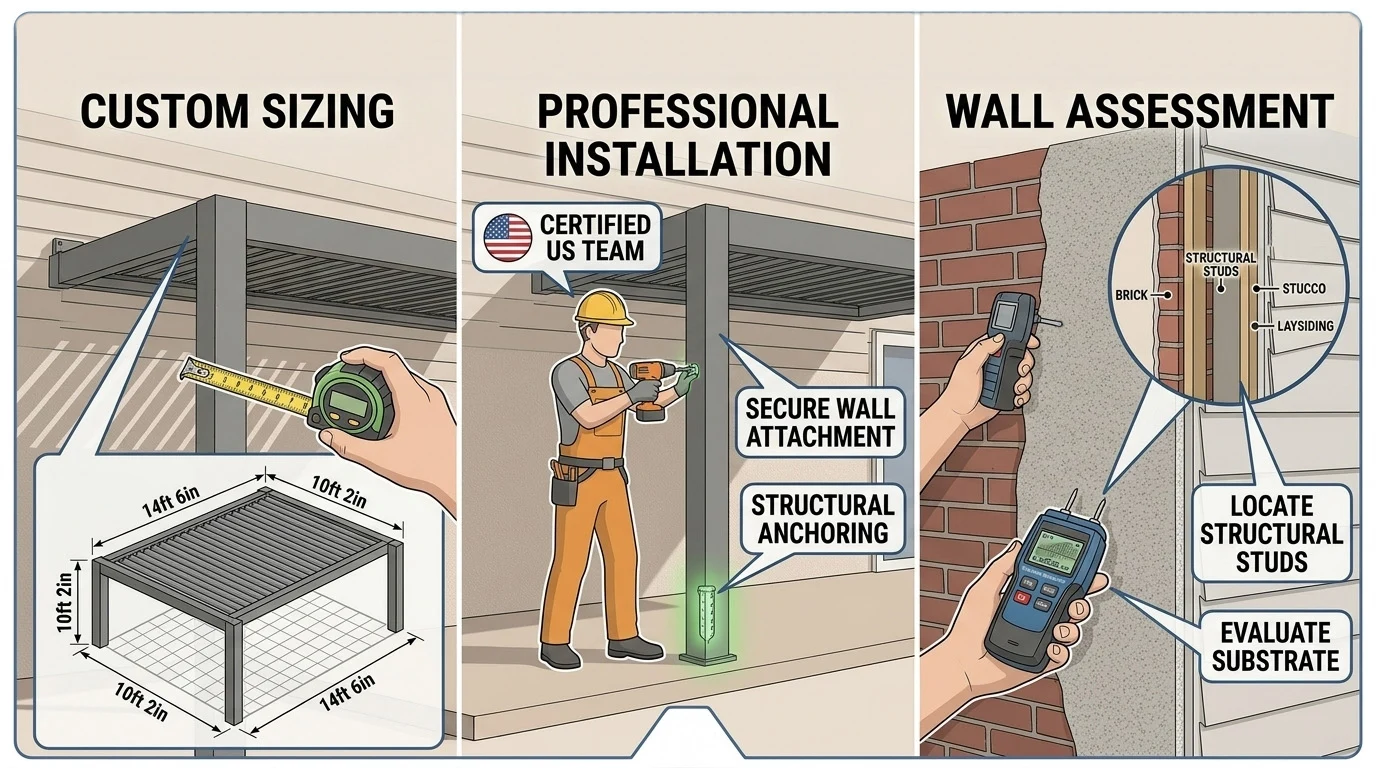
  • Custom Sizing: Can the system be engineered to your exact patio dimensions down to the inch?

  • Professional Installation: Does the company provide a certified US installation team that handles wall attachment, flashing, and structural anchoring?

  • Wall Assessment: A quality team evaluates your wall substrate (brick, stucco, lap siding) to locate structural studs before driving any lag bolts.

What DIY Kits Won't Tell You

Kit roundups rank products you assemble yourself. Here's what the star ratings don't surface:

  • The cost isn't just the kit price. A $2,000 kit becomes $2,000 + concrete footings + wall hardware + flashing + your weekend. And most kits aren't designed for wall mounting at all — they're freestanding. If you specifically need a wall-mounted pergola, you'll find almost no ready-made kit built for it; the affordable options stop at freestanding.
  • The engineering is where the money actually goes. A premium louvered roof's real cost is in the gasket seals, the motor, the integrated drainage channels, and the wind/snow load engineering. Budget kits cut corners there — which is why they leak in wind-driven rain and rattle in wind.
  • Waterproofing is a build detail, not a spec. Any seller can claim "waterproof." What matters is whether the louvers actually seal and whether the drainage actually works on your specific wall. That's verified in installation, not in an Amazon listing.
  • DIY kits and wall-mounted aren't usually the same product. Most affordable louvered kits are freestanding. If you want wall-mounted, you're already looking at the higher-end options — and that changes the whole comparison.

Scorecard in Action: A Real Wall-Mounted Installation

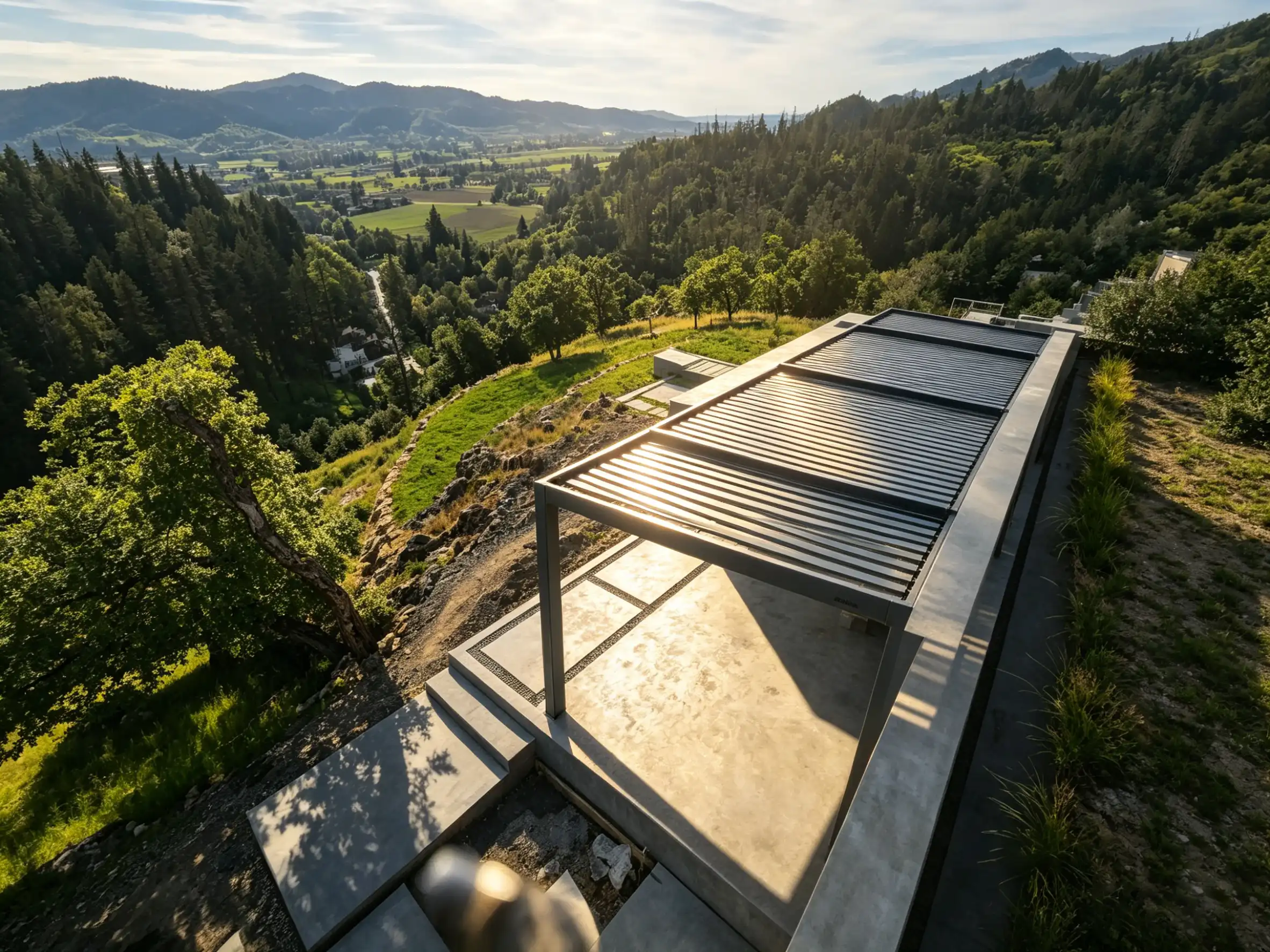
Let's run the scorecard on a real installation we completed: three connected 13x14 wall-mounted solar louvered pergolas in Houston, TX — forming one expansive structure across a large hillside villa terrace.

DimensionWhat Was DoneScore
Watertight roof & drainageMotorized gray louvers with rubber gaskets; integrated gutters drain through the posts5
Wind & snow ratingsEngineered for 130 mph wind, 30 PSF snow load5
Frame materialPowder-coated gray aluminum — no rust, no rot5
Power sourceSolar-powered motor, lights; no wiring to the house5
InstallationThree connected 13x14 units, wall-mounted to the villa; built-in lighting; US installation team5

Total: 5.0/5

The terrace sat on a hillside villa in Houston, fully exposed to sun and rain — a premium space going unused because nothing could cover it without blocking the valley views. Instead of one oversized structure, three wall-mounted 13x14 units were connected to create continuous coverage across the entire terrace. Each unit was attached to the villa's wall, keeping the open valley sightlines intact. The solar system powered the motor, lights, and fans with no electrician and no conduit across the concrete — which also solved the "no lighting after sunset" problem.

Result: A sprawling social zone for gatherings and BBQs that turned a wasted concrete terrace into a luxurious, low-maintenance outdoor living center — without disturbing the quiet interior of the home.

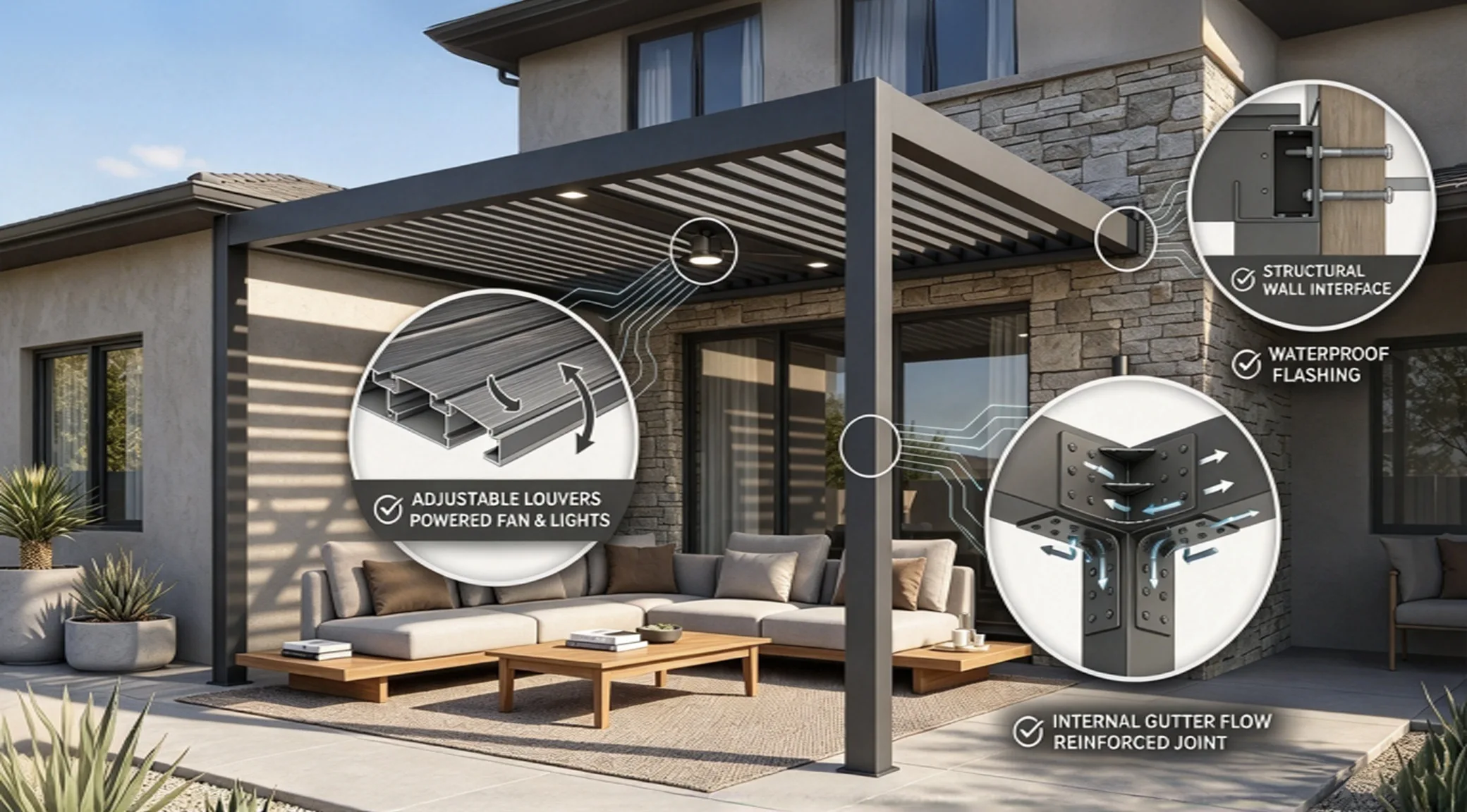
This is the system that made it possible — the motorized louvers, the integrated gutters that drain through the posts, and the solar roof that powers it all. Want to see how each part works? Take a look at the pergola itself.

Red Flags to Avoid When Shopping

Ask these questions before you commit. A "no" or a vague answer means walk away:

Red FlagWhy It Matters
"Wind resistant" without a numberNo engineering verification
"Waterproof" without drainage explanationLikely leaks in wind-driven rain
No custom sizingYou'll settle for a size that doesn't fit
No installation teamYou're doing the wall connection yourself
No wall assessmentThey'll bolt into siding, not studs
No clear snow load ratingWill fail in northern winters

The single question that filters out low-quality options: "What are the exact certified wind and snow load ratings, how does internal post drainage operate, and who handles the wall mounting?" A serious manufacturer will readily provide exact technical answers.

FAQs

What's the difference between a louvered pergola and a standard pergola?

A louvered pergola has adjustable aluminum slats that rotate from fully open to fully closed. Closed, they form a watertight roof with integrated drainage. A standard pergola has fixed slats that offer shade but no rain protection.

Are louvered pergolas worth the higher cost?

If you want year-round use — dry in rain, shaded in sun — yes. A louvered roof is the only pergola roof type that does both. Whether the premium is worth it depends on how often you'd use an open pergola vs. a fully weatherproof one. See our wall-mounted pergola with roof guide for the full roof type comparison.

How long does a louvered pergola last?

A quality powder-coated aluminum louvered pergola typically lasts 20-25+ years with minimal maintenance. The motor and moving parts may need servicing after 5-10 years, but the frame itself is a decades-long investment.

Can I add a louvered roof to my existing pergola?

Usually not without reengineering. Most existing pergolas — wood or budget aluminum — aren't built to support the weight and wind load of a motorized louver system. It's almost always cheaper to install a new, engineered louvered pergola than to retrofit.

Do wall-mounted louvered pergolas need permits?

Almost always, yes. Because they attach to your house and add a structural roof system, they're treated as structural additions. Call your local building department before ordering. See our installation guide for the full permit picture.

Can a louvered pergola handle snow?

Quality aluminum louvered pergolas are rated for 30 PSF snow load or higher. The louvers can be opened or angled to shed snow. Always confirm the snow load rating with the manufacturer for your region — never accept a structure without one in a snowy climate.

Is a solar louvered pergola more expensive than a wired one?

The upfront cost is slightly higher, but solar eliminates the electrician, conduit, permit inspection, and monthly electricity bill. Over a decade, the solar system typically pays for itself — and it removes the most leak-prone part of a wall-mounted installation.

Conclusion

"Best wall-mounted louvered pergola" isn't a brand — it's a product that meets five standards: a truly watertight roof with proper drainage, real wind and snow ratings, a durable aluminum frame, a clean power source, and professional installation. Kit roundups serve budget DIY buyers who want to assemble a structure themselves. If you want a wall-mounted louvered pergola that matches your house, handles your climate, and lasts decades, judge every option with the scorecard. Ask for the numbers, check the drainage, verify the ratings, and make sure someone qualified installs it. That's how you find the best pergola for your house, not the one that ranks first on a shopping list. Request a quote and we'll help you run the scorecard against your specific patio.

Back to top of page
crossmenu